
If you only read one thing, read this: a 4K disc is always better than a 4K stream.
And more often than people want to admit, an old-school 1080p Blu-ray is better than a 4K stream, too.
I don’t state this as a movie collector. This isn’t a vinyl die-hard claiming qualitatively that their record sounds better than your CD. This is math. This is bandwidth. This is physics.
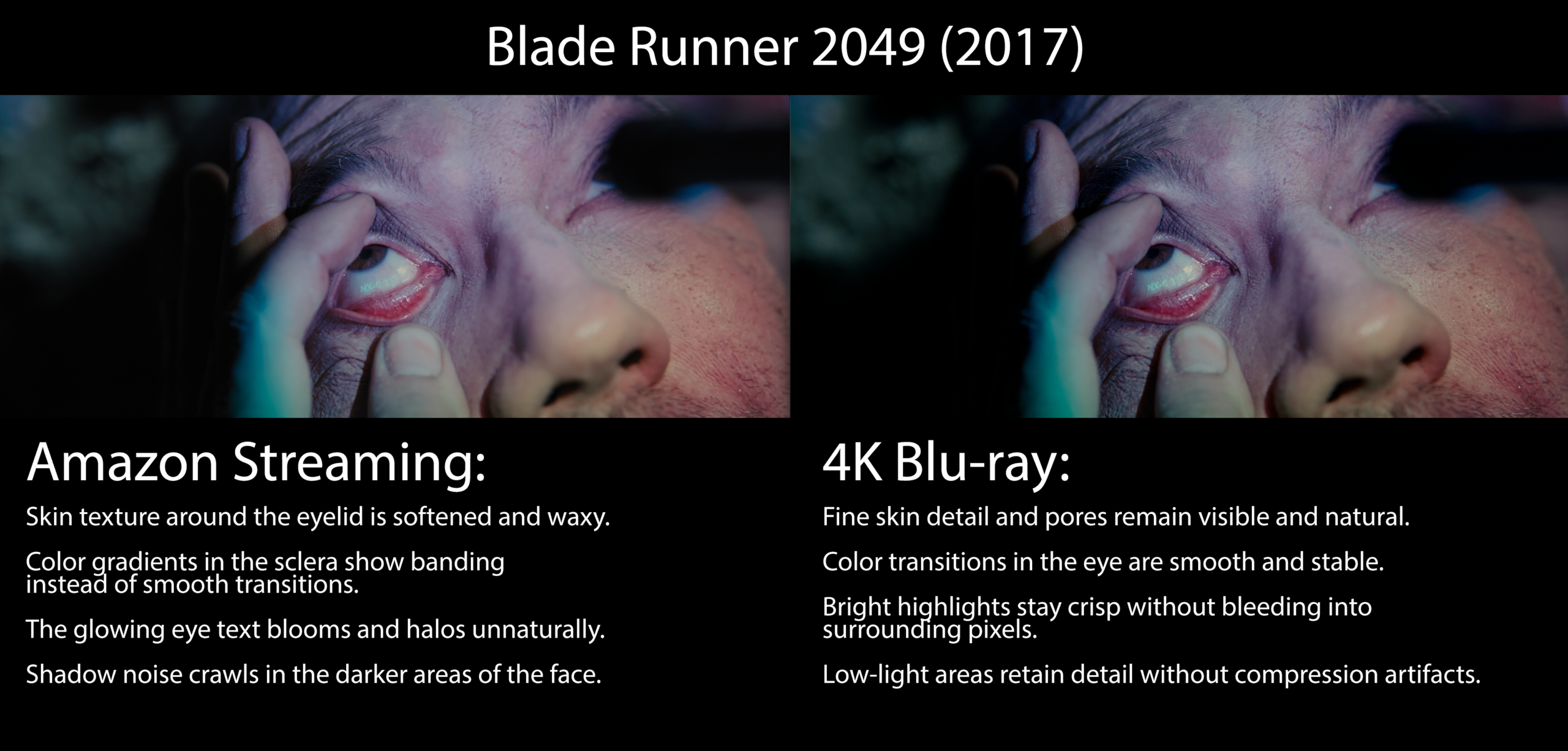
An eye-opening difference (Click Image for High Res)
File Size: What Really Makes a Movie Move
A typical two-hour movie on a 4K UHD disc is usually 60–90GB, sometimes more. A 4K movie streamed online is typically 10–20GB. That means the disc is carrying anywhere from 200% to 800% more data than the stream. If you think you’re getting the same quality out of a file that much smaller, you’re not. Not even remotely.
The mistake people make is focusing on resolution. Both say 4K, so they assume the experience is the same. Hell f***ing no.
4K refers to resolution, the number of pixels on your screen. An old-school standard-definition DVD (in the US, NTSC format) was called 480p and had a resolution of 720 pixels by 480 pixels (about 350k total pixels per frame). Blu-ray upped the game with 1080p resolution (1920×1080), or a bit over 2 million pixels per frame. Now 4k quadruples that, at 3840×2160 resolution, or about 8.3 million pixels per frame.
Those are impressive numbers. They sell televisions, projectors, and streaming movies. But there’s a lot more to picture than just how many pixels you see.
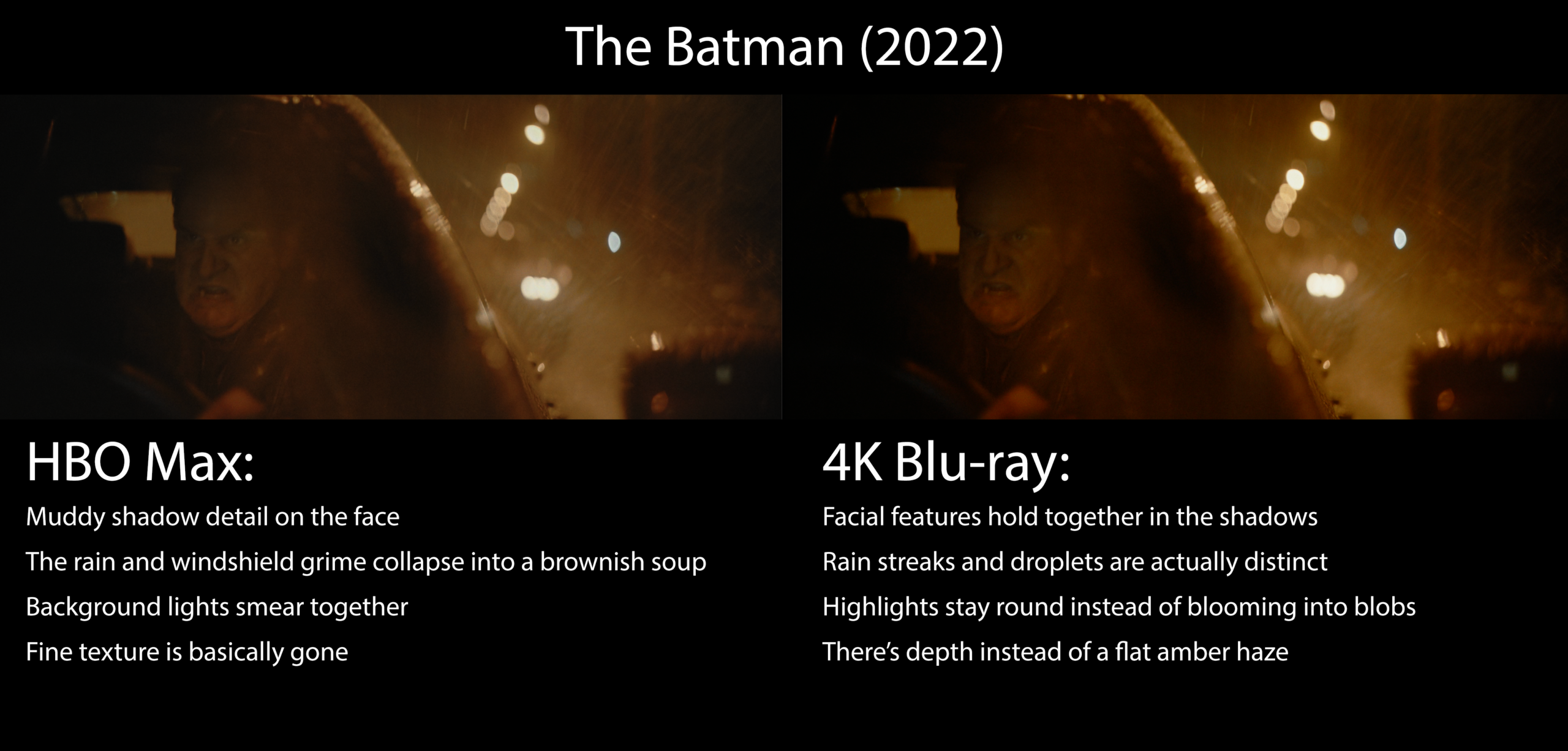
(Click Image for High Res)
There’s a number more important than resolution, and it’s one that streamers want to hide: bitrate. That’s how much data is delivered per second. Both streaming and disc give you roughly 8 million pixels on your screen, but the bitrate determines how well those pixels are filled.
When streaming a 4K movie, your bitrate might peak around 25 Mbps if your internet, your local network, and the service itself are all at peak with few others sharing that server. More often, it’s closer to 10–15 Mbps. A 4K disc, on the other hand, is commonly encoded at 50–100 Mbps, and sometimes higher.
Same resolution. Wildly different data. And that extra data is everything.
At a high bitrate, fine detail holds together; at a low bitrate, it breaks apart. With a proper bit rate, the film grain looks like grain; with a lower bitrate, you will instead see digital mush. With the data offered by disc gradients in skies, fog, and shadows, the colors remain smooth, whereas when streaming the same images, they produce blocky, stripy bands of color (a compression artifact known as banding).
With a good bitrate, dark scenes, especially nighttime or space scenes, retain texture instead of collapsing into blobs. Motion holds up during fast camera moves instead of turning into a smeary mess. If you’ve ever streamed a movie where a night scene suddenly looks like digital soup, that’s not the movie. It’s the bitrate.
Streaming quality is also inconsistent by design. It depends on your connection, what else is happening on your network, how many people are hitting the service at the same time, and how aggressively that service is throttling data. Sometimes a stream looks fine. Sometimes it looks awful. Sometimes the quality drops halfway through the movie. A disc never does that. You get the same image every time, period.
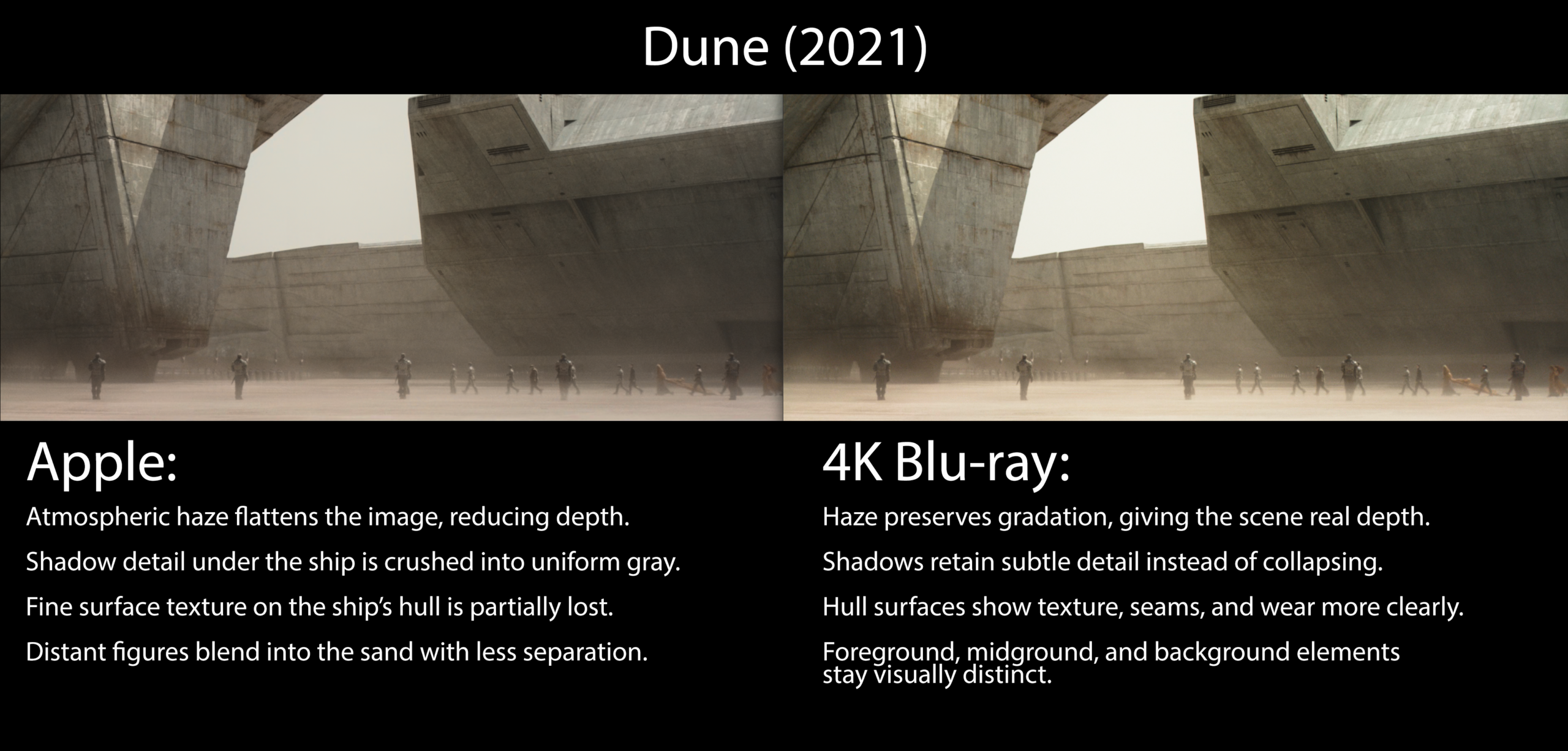
(Click Image for High Res)
But what about HDR and Dolby Vision? Doesn’t that make a stream better?
Even if the stream advertises HDR or Dolby Vision that is lacking on the 4K disc, the disc often still wins overall. The higher bitrate preserves subtle color differences, cleaner motion, and more stable shadows. Compression hurts motion first, and streaming is always more compressed. HDR can help a stream, but it doesn’t magically replace data that was never there to begin with.
Differences You Can See and Hear.
Comparing the sound quality of a streaming movie to a disc isn’t even a fair fight.
A 4K disc uses lossless audio. Whether that’s Dolby TrueHD, DTS-HD Master Audio, or Atmos, it’s carried in a lossless container. Streaming audio is always compressed. Even when it says “Atmos,” it’s usually Dolby Digital Plus.
This isn’t nerd trivia. You can hear it immediately in fuller dynamics, cleaner dialogue, and better separation between channels.
I wince when I see people build elaborate 7.4.2 home theater systems and then feed them streaming audio. If streaming is “good enough,” just buy a soundbar and be done with it.
Now, if you’re watching on a small screen and using built-in TV speakers, discs probably aren’t worth the hassle. But if you care about image stability, dark-scene detail, motion clarity, audio quality, and anything resembling a cinematic presentation, there is no substitute for a disc.
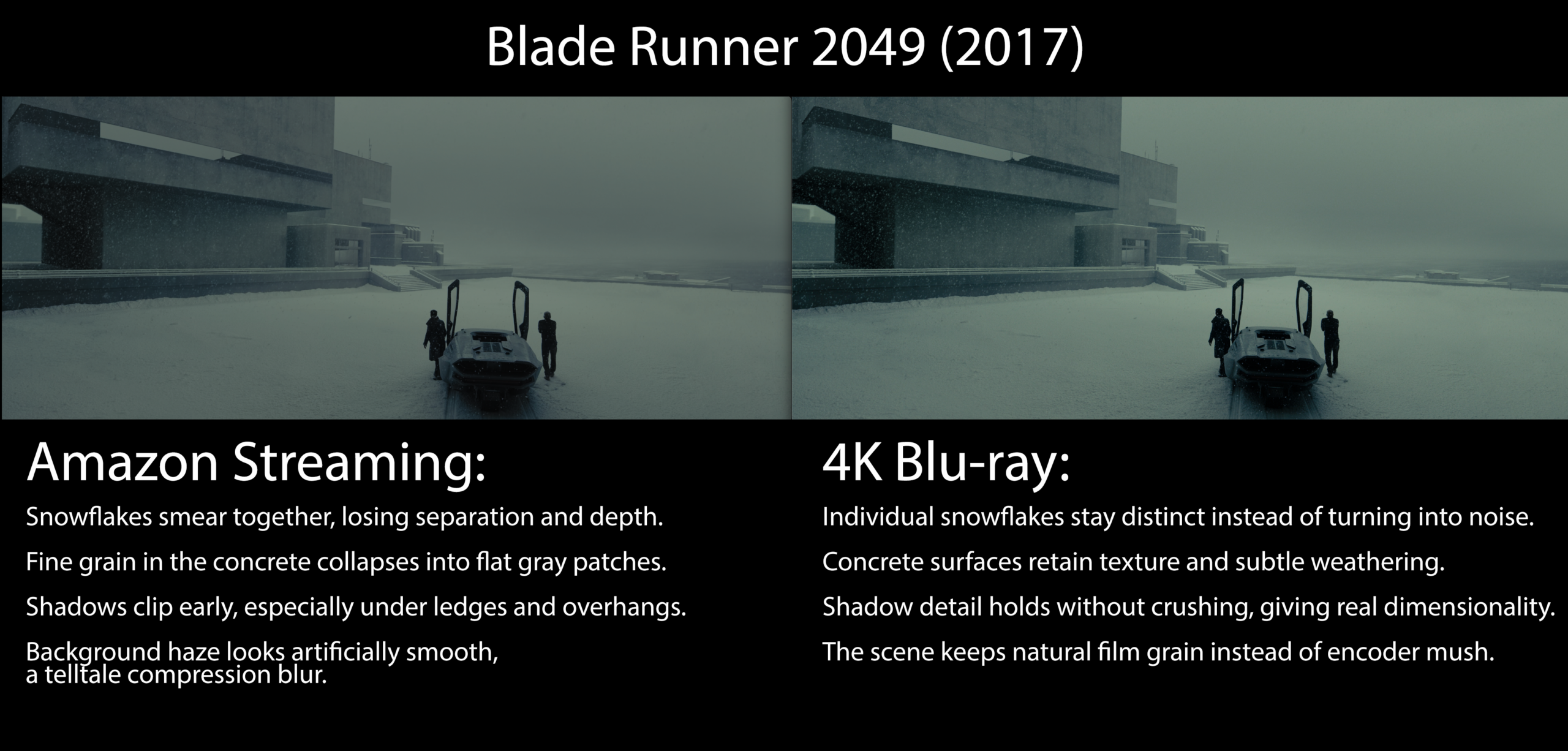
(Click Image for High Res)
Why Even A 1080p Blu-ray Often Beats a 4K Streaming Film
So a disc is better than streaming at an apples-to-apples 4k comparison. That’s easy math. Want to get stickier? A 1080p Blu-ray is often better than a 4K stream, too.
A two-hour movie on Blu-ray is typically 20–35GB, while a 4K stream is still sitting around 10–20GB. Blu-ray bitrates commonly hit 30–40 Mbps, while streaming lingers around 12–20 Mbps.
Even with fewer pixels, the Blu-ray often has more actual picture data. The result is a sharper, more stable image with proper grain, clean gradients, and solid motion. The 4K stream may have more pixels, but they’re starved for data and get smeared by compression.
That’s why what fills your pixels matters more than how many pixels you have.
Audio follows the same pattern. Blu-ray offers lossless DTS-HD MA or TrueHD. Streaming gets lossy Dolby Digital Plus. Even if a 4K stream offers Atmos while the Blu-ray doesn’t, the disc often still sounds bigger and cleaner.
If the streaming 4K version has HDR or Dolby Vision, video modes Blu-ray doesn’t offer, I might call it a toss-up, but it’s never a clear win for streaming.
Digital “Ownership” Isn’t Ownership
Then there’s the question of: if you want to watch the film in a year, what did you actually buy?
Streaming services with a monthly charge constantly rotate their content. That’s to be expected (even if customers still complain when Disney+ pulls Willow or Netflix loses Star Trek). But here’s the part people ignore: even movies you “buy” digitally can be taken away.
This isn’t theoretical. I bought a short-lived FX sitcom called Testees from Amazon. A few years later, they lost the rights. The show was removed. No notice. No refund. No compensation. No way to watch it again.
Regulators in the EU and UK have already challenged the use of the word “buy” for digital movies, because what you’re actually purchasing is a revocable license, not ownership.
No one is coming into your house to take your discs because a contract has expired. Your digital library exists at the pleasure of corporations and licensing agreements. It is always one pen stroke away from deletion.

(Click Image for High Res)
TL;DR Version:
Yes, streaming is more convenient. Convenience lies. Reliability doesn’t.
A 4K disc always beats a 4K stream, and embarrassingly often a 1080p Blu-ray does too.


